Copper IUDs in Perimenopause: What Clinicians and Patients Need to Know
The conversation around contraception for women over 40 has been transformed by the growing awareness of perimenopause — a transition phase that can last 4–10 years and is characterised by hormonal fluctuation, irregular cycles, and sometimes significant physical and psychological symptoms. Despite this, contraception for women in their 40s remains underserved in both clinical practice and patient education.
The copper intrauterine device (Copper IUD) is one of the most well-suited contraceptive options for this life stage — yet it is rarely discussed in the context of perimenopause. This article addresses the clinical evidence, practical guidance, and common questions that arise when counselling women over 40 on IUD use.
Why Contraception Still Matters Over 40
The most common contraceptive myth among women in their 40s is that pregnancy risk disappears as periods become irregular. It does not. While fertility declines with age, ovulation remains possible throughout perimenopause — and an unintended pregnancy in this decade carries significantly higher maternal and foetal risks than in a younger woman.
According to the FSRH (Faculty of Sexual & Reproductive Healthcare) guideline on contraception for women over 40, effective contraception should continue until natural menopause is confirmed. The definition: one year of amenorrhoea (no periods) after the age of 50, or two years of amenorrhoea before the age of 50.
Perimenopause is not a contraceptive. A woman who has not had a period in 6 months at age 46 may still ovulate and conceive. Clinicians should communicate this clearly.
WHO and FSRH Guidance on IUD Use in Women Over 40
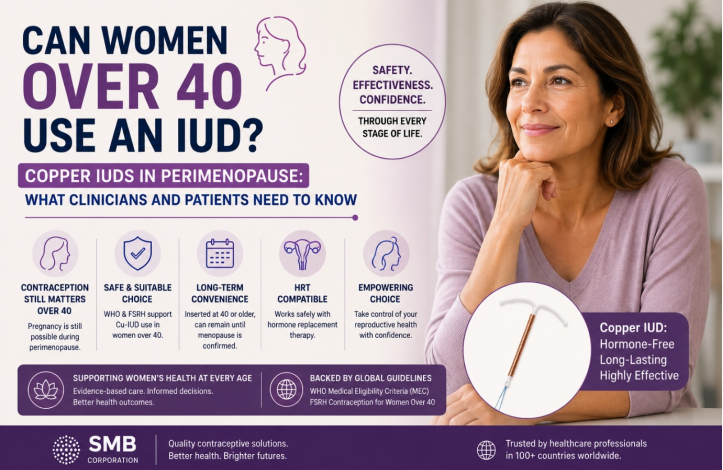
Both the World Health Organization Medical Eligibility Criteria (WHO MEC) and the FSRH support IUD use in perimenopausal women. There is no age-based upper limit for Copper IUD insertion.
The FSRH guideline specifically states that a Copper IUD inserted at or after age 40 can remain in place until the woman no longer needs contraception — typically when menopause is confirmed. This eliminates the need for re-insertion and provides uninterrupted, highly effective protection through the perimenopausal transition.
Key guidance points:
- Copper IUD inserted at age 40 or older: can be retained until one year after the last menstrual period (if the woman is over 50) or two years after (if under 50) — consistent with FSRH and WHO guidance
- No evidence of increased complication risk specifically related to perimenopausal status
- Expulsion rates are lower in women who have had previous pregnancies — which includes most women over 40 seeking contraception
- Uterine pathology (fibroids, polyps) becomes more common in this decade and should be assessed before insertion — a routine consideration, not a blanket contraindication
Non-Contraceptive Considerations: What Patients Often Don’t Know
For many women in perimenopause, the contraceptive choice interacts with other health concerns specific to this life stage. The Copper IUD has no systemic hormonal effect — which is a significant advantage for women who want to avoid hormonal contraception, are using other hormonal therapies, or who have conditions that make hormonal methods inappropriate.
H3:For Women Using HRT (Hormone Replacement Therapy)
Women who choose systemic HRT for menopausal symptom management can use the Copper IUD simultaneously without interaction. The IUD provides contraceptive protection; HRT addresses vasomotor and other menopausal symptoms. The two serve different functions and do not interfere with each other.
H3:For Women Who Cannot Use Hormonal Methods
Women with a history of hormone-sensitive cancers, certain cardiovascular conditions, or who have experienced significant side effects from hormonal contraception have limited options. The Copper IUD is one of the few highly effective, non-hormonal long-acting methods available to this population.
H3:For Women Who Have Chosen Copper for Philosophical Reasons
An increasing number of women in their late 30s and 40s are actively seeking non-hormonal contraception as part of a broader preference for minimal pharmaceutical intervention. The Copper IUD serves this group effectively through the perimenopausal transition without requiring method changes.
Managing Perimenopausal Bleeding With a Copper IUD
The most clinically nuanced aspect of Copper IUD use in perimenopause is bleeding management. Copper IUDs increase menstrual flow in many users — and perimenopausal cycles are already irregular and sometimes heavy. This can create diagnostic ambiguity and patient distress.
Distinguishing IUD-Related Bleeding from Perimenopausal Changes
Clinicians and patients need a framework for interpreting bleeding changes in this context:
- Heavy or prolonged bleeding is expected with a Copper IUD — this may be amplified during perimenopause when oestrogen fluctuations already increase flow
- Intermenstrual bleeding may reflect either perimenopausal irregularity or IUD response — clinical assessment (ultrasound, endometrial sampling if indicated) should guide management
- Postmenopausal bleeding (defined as bleeding more than 12 months after the last period) requires endometrial investigation regardless of IUD presence — the IUD does not change this clinical rule
For women who find heavy bleeding unmanageable with a Copper IUD, a hormonal IUD (LNG-IUS) or progestogen-only options may be clinically preferable. The conversation should be revisited at the 12-month follow-up if bleeding concerns are significant.
When to Remove the Copper IUD: A Clinical Timeline
A common question from both patients and providers: when should the IUD be removed?
The FSRH guideline is clear:
- If the IUD was inserted at age 40 or older, and the woman is now past her last menstrual period by 12 months (and over 50): the IUD can be removed — contraception is no longer required
- If the woman is under 50 and amenorrhoeic: continue for 24 months before removal
- If the woman wishes to confirm menopause with FSH testing: note that FSH levels are unreliable in Copper IUD users, as the device does not suppress ovarian hormone production. FSH testing is not the primary tool for confirming menopause in this group — clinical criteria (age, duration of amenorrhoea) are more reliable
Clinical note: Do not measure FSH to confirm menopause in Copper IUD users. Results are unreliable and can be misleading. Rely on age and amenorrhoea duration per FSRH guidance.
Counselling Points for the Over-40 Consultation
When counselling a perimenopausal woman on the Copper IUD, the following points should be covered:
- Confirm ongoing contraceptive need — irregular cycles do not mean infertility
- Explain that a Copper IUD inserted now may be the last contraceptive device she ever needs
- Discuss likely bleeding changes — honesty about increased flow prevents early discontinuation
- Address the HRT question — many women in this decade are considering or already using HRT; confirm the IUD is compatible
- Set a clear removal plan based on age and amenorrhoea criteria — this gives the patient a sense of the endpoint
- Screen for uterine pathology (transvaginal ultrasound) before insertion if not recently performed
The Bigger Picture: Perimenopause and Reproductive Health
The global conversation around perimenopause and menopause has expanded significantly in the past five years, driven by advocacy campaigns, mainstream media coverage, and a new generation of women demanding better healthcare in midlife. Contraception is an integral part of this conversation — yet it is routinely omitted from menopause clinics and perimenopausal healthcare pathways.
Gynaecologists, GPs, and women’s health providers who integrate contraceptive counselling into perimenopausal care are providing genuinely complete healthcare. The Copper IUD, with its hormone-free profile, long duration, and compatibility with HRT, is an important clinical tool in that integrated care model.
Conclusion
Women over 40 need and deserve the same access to evidence-based contraceptive counselling as any other age group. The copper IUD is a safe, highly effective, and often ideal choice for the perimenopausal woman — and one that can simplify an often confusing and emotionally complex health transition. Clinicians who proactively offer it as part of the perimenopausal care conversation are filling a genuine clinical gap.
SMB Corporation’s CuT 380A copper IUD is effective for up to 10–12 years and widely used in women’s health programs globally. Visit www.smbcorpn.com for product information and clinical resources.